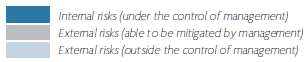
The material risks identified by the group in terms of their probability and potential impact on Hyprop are shown below. Each risk has been mapped to
the strategic objective on which it could have an impact, affected stakeholders, management’s strategic response and related key performance indicators
Hyprop’s system of internal control is designed to provide reasonable assurance as to the integrity and reliability of the financial statements. By managing
rather than eliminating applicable risks, these systems are intended to safeguard, verify and maintain accountability of the company’s assets. Equally,
they are designed to identify and minimise significant fraud, potential liability, loss and material misstatement, while complying with applicable laws and
regulations.
The board reviews and monitors the efficacy of systems of internal control, assisted by the audit and risk committees. These committees in turn are
assisted by management reporting and periodic reviews, as well as reports from an outsourced internal audit service provider. The committees report
to the board on the findings of the internal audit function.
Executive management implements controls to ensure the validity, accuracy and completeness of financial information. These controls are reviewed by
internal and external audit. External audit reports on the fair presentation of financial information at statutory reporting level. On an operational level,
this is done by the executive committee.
The risk committee is constituted as a subcommittee of the board. The committee has an independent role, operating as an overseer and makes
recommendations to the board for its consideration and final approval. The committee does not assume the functions of management, which remain
the responsibility of the executive directors, officers and other members of senior management. The role of the committee, inter alia, is to adopt and
implement an appropriate risk management policy, which is in accordance with industry practice. For further detail in respect of the role and mandate
of the risk committee, please refer to the risk committee charter online.
| |
|
Strategic
objective |
|
Key risk |
|
Probable effects |
|
Severity
of risk |
|
Stakeholder |
|
Strategic response/mitigation |
|
Key performance indicator |
 |
|
|
|
|
|
|
|
|
|
|
|
|
|
|
 |
|
Focus on
sustainable
income growth |
|
Low GDP growth impacts business growth in
South Africa |
|
 |
Slower retail sales growth affects retailers’
financial positions and ability to pay rent |
|
|
High |
|
|
Providers of capital (debt and equity investors and financial institutions) |
|
Tenants |
|
Mall customers |
|
|
|
Facilitate strong trading environments by developing shopping
destinations of choice, offering an attractive tenant mix with
exciting brands and flagship stores in a safe, clean and friendly
environment |
|
|
Arrears, trading densities, rent affordability |
| |
|
Slowdown in consumer spend affecting
retailers’ trading densities and rent ratios |
|
|
Small line stores under pressure |
|
Leases not renewed |
|
Discounted rentals to retain tenants |
|
Lower distributable income |
|
|
High |
|
|
Tenants |
|
Providers of capital (debt and equity investors, financial institutions) |
|
Mall customers |
|
|
|
Hyprop malls are well established, in dominant locations and
often attract flagship stores |
|
Contractual lease income with financially sound tenants (most
tenants are reputable national companies with strong balance
sheets and proven business models) |
|
Increase shopper time spent in malls, through initiatives such as
wi-fi and active marketing and social media strategies |
|
Provide geographic diversification (eg sub-Saharan expansion) |
|
|
Arrears, trading densities, rent affordability |
| |
|
Potential increase in interest rates |
|
|
Increased borrowing costs result in reduced
distributable income |
|
|
Low |
|
|
Providers of capital (debt and equity investors and financial institutions) |
|
|
|
Increased borrowing costs result in reduced distributable income |
|
94,5% of debt fixed for 5,2 years, and staggered fixed interest rate |
|
Proactive management of interest-bearing borrowings |
|
|
Maturity profile, cost of funding |
| |
|
Downgrading of sovereign credit rating |
|
|
Growth and national/global competitiveness at risk |
|
Reduced foreign direct investment |
|
Increased borrowing costs |
|
|
Medium |
|
|
Providers of capital (debt and equity investors and financial institutions) |
|
|
|
Provide economic and geographic diversification through sub-Saharan investments |
|
High ratio of fixed debt |
|
Introduction of unsecured debt in the form of debt capital market funding (DCM) |
|
|
Distribution growth |
 |
|
Focus on
sustainable
income growth |
|
Increased supply of retail space in the market |
|
|
Discounted rentals to retain tenants |
|
Tenants become more demanding on leasing terms |
|
Increased vacancies |
|
Leases not renewed |
|
Increased pressure on renewal terms |
|
Lower rental growth |
|
|
High |
|
|
Tenants |
|
Providers of capital (debt and equity investors, financial institutions) |
|
Mall customers |
|
|
|
Meet tenant demand through extensions and tenant relocations |
|
Demand for space in Hyprop centres continues to outstrip
supply, resulting in a strong pipeline of prospective tenants |
|
The executive committee meets monthly to discuss
operational performance |
|
|
Leasing activity, rental growth,
contractual escalations, workload
(percentage of total leases
expiring in one financial year) |
| |
|
Tenants more cautious on renewals and new lettings |
|
|
Inability to renew leases or retain tenants means
increased vacancies and prolonged periods of
vacant space in shopping centres |
|
|
Medium |
|
|
Tenants |
|
Providers of capital (debt and equity investors, financial institutions) |
|
Mall customers |
|
|
|
Close engagement with tenants throughout their tenure |
|
|
Workload |
| |
|
Tenants taking less space and slower extension plans |
|
|
Negative impact on budgets |
|
|
Medium |
|
|
|
Stagger major lease expiries |
|
|
| |
|
Significant volume of leases expiring in any one period |
|
|
Negative rent reversion |
|
|
Medium |
|
|
|
Proactively manage lease expiries |
|
|
| |
|
Lease renewals and tenant retention |
|
|
Discounted rentals to retain tenants |
|
|
Medium |
|
|
|
Ensure a strong pipeline of prospective tenants |
|
|
| |
|
Restrictive clauses in leases |
|
|
Discounted rentals to retain tenants |
|
|
Medium |
|
|
|
Monthly lease expiry and related workload reports to executive committee |
|
|
 |
|
Continuous
portfolio
improvement |
|
Dilutionary acquisitions, developments and
disposals |
|
|
Lower growth in distributions |
|
|
Medium |
|
|
Providers of capital (debt and equity investors, financial institutions) |
|
|
|
Regular review of strategy against macro-economic environment, operating landscape, returns and risk tolerance |
|
Disposal of non-core assets |
|
|
Approved investments and
disposals with long-term growth
objective |
| |
Capital budget exceeded for development/redevelopment |
|
|
Project yield compromised |
|
Inefficient capital allocation |
|
|
Medium |
|
|
|
Monthly monitoring of capital expenditure |
|
Detailed analysis and research prior to approval |
|
|
| |
Ineffective progress monitoring for
development/redevelopment |
|
|
Project end date being compromised, escalating
project costs and the yield being compromised. |
|
|
Medium |
|
|
|
Meet pre-letting requirements |
|
Ongoing review of design and monitoring of construction by development and centre management and the project professional team |
|
|
 |
|
Attracting and retaining the best people |
|
Current BEE level of 6 |
|
|
Major tenants prefer landlord to have reasonable BEE rating |
|
Potential impact on corporate activity in SA |
|
Potential for regulatory penalties |
|
|
High |
|
|
Providers of capital (debt and equity investors, financial institutions) |
|
Employees |
|
Suppliers |
|
Tenants |
|
|
|
Identified as a strategic imperative. Plan in place to achieve incremental and sustainable improvements |
|
|
Independent BEE rating |
| |
|
Negative impact of the new codes |
|
|
|
|
|
| |
|
Transformation required in ownership, directors and senior management |
|
|
|
|
|
 |
|
Operating an environmentally sustainable business |
|
Potential introduction of carbon tax
in 2016 |
|
|
Increased operational costs |
|
|
High |
|
|
Tenants |
|
Community |
|
Employees |
|
Suppliers |
|
|
|
Environmental, social and governance (ESG) strategy document serves to provides context and guidelines for implementation |
|
|
Improved energy efficiency |
| |
|
Failure to meet primary targets (for energy,
water, recycling and carbon consumption) |
|
|
Possible reputational damage with the investment community |
|
|
 |
|
Providing the highest level of service to our tenants |
|
Increased cost of occupancy due to electricity
price increases |
|
|
Unable to recover tenants’ portion of
consumption means lower distributable income |
|
|
High |
|
|
Mall customers |
|
Tenants |
|
Municipal authorities |
|
|
|
Numerous projects under way to reduce consumption |
|
|
Cost of occupancy – electricity consumption |
| |
|
Negative impact of disruptive electricity
supply on the economy and at Hyprop malls |
|
|
Lower rentals to retain certain tenants |
|
Prolonged periods of power outages resulting in
sub-optimal trading condition |
|
|
|
|
|
Successful objection to incorrect valuations |
|
1 500kWp, solar photovoltaic plant at Clearwater Mall |
|
|
| |
|
Increase in capital cost to provide more
generators |
|
|
Increased electricity and diesel costs |
|
|
|
|
|
Introducing smart metering |
|
Energy-saving and similar initiatives |
|
|
 |
|
Providing the
highest level
of service to
our tenants |
|
Increased cost of occupancy from rates, taxes
and utilities |
|
|
Cost and supply of electricity and water |
|
Excessive increase in cost of occupancy impacting
recoveries and renewals |
|
|
Medium |
|
|
Tenants |
|
Mall customers |
|
Providers of capital (debt and equity
investors, financial institutions) |
|
|
|
Numerous projects under way to reduce consumption |
|
Tenants guided by tenant criteria document, with guidelines on reducing electricity consumption |
|
Introducing smart metering |
|
|
Cost of occupancy – water, rates
and electricity consumption |
| |
|
Deterioration of municipal administration and
service delivery |
|
|
Incorrect utility billings |
|
Delays in transfer of acquisitions and disposals |
|
Inadequate services provided |
|
Billing errors |
|
Excessive lead times for town planning approval |
|
|
High |
|
|
Tenants |
|
Providers of capital (debt and equity
investors, financial institutions) |
|
Mall customers |
|
|
|
Working closely with professional consultants to optimise local
authority approval processes and to minimise negative impact
of billing errors |
|
|
Town council approvals received,
utilities recovered |
 |
|
Providing the
highest level
of service to
our tenants |
|
Increased levels of crime at shopping centres |
|
|
Hyprop forced to spend more capital on security
equipment |
|
Crime, robberies, theft, etc at shopping malls |
|
Negative impact on footfall |
|
Reputational damage for Hyprop and for its malls |
|
|
High |
|
|
Mall customers |
|
Tenants |
|
Community |
|
|
|
Improve quality of service provider and security equipment |
|
Better engagement between shopping centre staff, service
provider, community and local police |
|
|
Improvement in crime statistics
at shopping malls |
 |
|
Increase
portfolio and
geographic
diversification |
|
Weakening of currencies placing local tenants
under pressure |
|
|
Unable to repatriate funds due to illiquid currency markets or capital restrictions |
|
Reduced distributable income |
|
Excessive volatility in exchange rates |
|
|
High |
|
|
Tenants |
|
Mall customers |
|
Providers of capital (debt and equity
investors, financial institutions) |
|
|
|
Matching debt with income (USD) |
|
Consider hedging exposure in terms of material dividends
received |
|
|
Size of dividend (current
percentage of income) |
| |
|
Slowdown in consumer spend |
|
|
Small line stores under pressure |
|
Leases not renewed |
|
|
High |
|
|
Tenants |
|
Mall customers |
|
Providers of capital (debt and equity
investors, financial institutions) |
|
|
|
Hyprop malls are well established, in dominant locations and
often attract flagship stores |
|
Strong lease agreements with financially sound tenants (most
tenants are reputable national companies with strong balance
sheets and proven business models) |
|
|
Arrears, trading densities, rent
affordability |