


 43 / 148

Hyprop Investments Limited
Integrated annual report and consolidated financial statements
2017
41
Investing in South Africa
Industry snapshot
The JSE-listed property sector in South Africa remains healthy, with over
40 companies managing assets exceeding R486 billion. During the year,
property indices were revised to reflect structural changes to the sector.
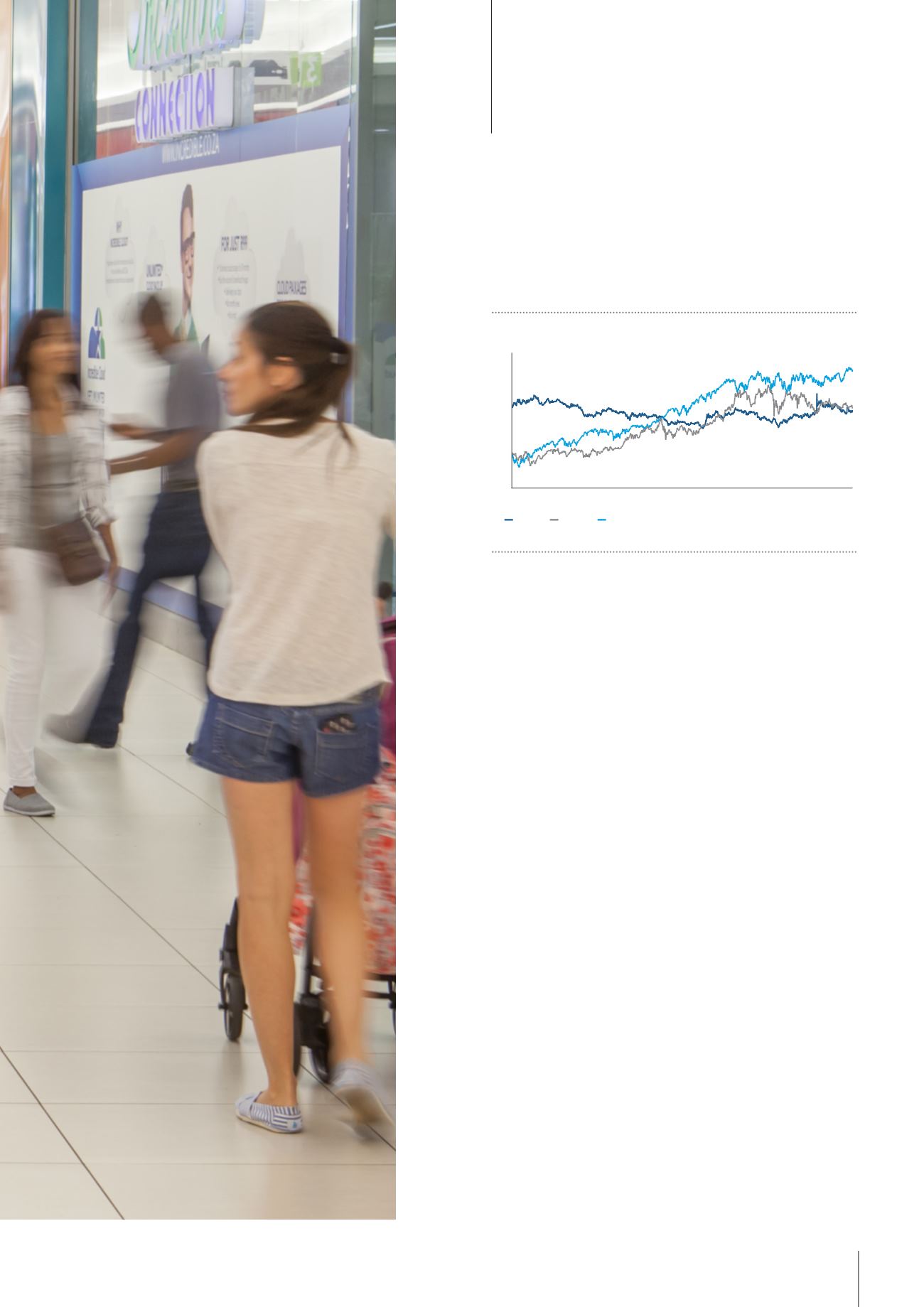
The SA REIT index now has 24 constituents, with a market capitalisation of
over R380 billion. Over the past 10 years to June 2017 the REIT sector has
generated better total returns than all the other asset classes on the JSE.
TOTAL RETURN INDICES
Source: I-Net bridge and Bridge Fund Managers
SAREITs
All share
Allbond
2009
2010
2011
2012
2013
2014
2015
2016
2017
1 200
1 000
800
600
400
Averaged total returns of the local REIT sector deteriorated in the first half
of the 2017 calendar year partly in response to negative news in the retail
sector that included the Stuttafords group being placed under business
rescue. Weaker trading conditions in the retail sector were exacerbated by
political and economic developments in South Africa, detailed below.
The attractiveness of property as a high-yielding asset class remains intact,
as evident in the R11 billion in fresh capital raised by the listed sector
through rights offers and private placements over the six-month period to
June 2017. Most of the capital invested in the sector has been focused on
offshore property counters, suggesting that investors are becoming
increasingly cautious about the outlook for the local economy.
South Africa’s macro-economic environment is cause for concern. GDP
growth has slowed markedly in recent years, reaching a low of just 0,3% in
2016, with only a moderate rebound expected this year. With
unemployment at an historical high of almost 28% and rising inflation,
particularly for food, consumer spending is under severe pressure. Reserve
Bank figures show that real household spending rose just 0,8% in 2016, but
has dropped steadily in the first half of 2017. In addition, SA household
debt levels remain very high, at well over 70% of income.
By the second quarter of calendar 2017, the country was in recession for
the first time since 2008. It was also dealing with unprecedented levels of
political uncertainty after President Zuma changed his cabinet and
removed the highly respected Pravin Gordhan as finance minister, a move
that precipitated a downgrade of South Africa’s investment-grade status
by two ratings companies for the first time in 17 years (and later, a third
downgrade). Economists agree that, in view of the volatile socio-political
outlook and weaker-than-expected macro-economy, trading conditions
are expected to be more challenging for the rest of the year.
More positively, and despite a poor performance in the first quarter, the
domestic retail sector rose 2,9% year on year in June 2017, according to
Statistics South Africa. While overall spending is a driver of the economy,
depressed consumer confidence is expected to keep retailing, in particular,
constrained.
Consecutive years of poor economic growth and retail space expansion in
South Africa are now evident with pressure on leasing and renewal rates,
as well as the overall performance of shopping centres. This is likely to
translate into a lower distribution growth trend across the property sector.
The markets
in which
we operate