
Human capital
Human capital: employee development
Our people are key to business performance. Our human resources strategy therefore focuses on attracting and retaining talented people whose values are aligned with the company's culture.
We offer competitive remuneration and comprehensive training support and skills transfer. Performance targets and training and skills development are reviewed annually and aligned with the group's strategy.
Hyprop complies with employment laws and is committed to protecting human rights. Our code of ethics and our disciplinary code are communicated to all employees. We have zero tolerance for discriminatory behaviour.
Our people are committed to our core employee values:
- Excellence – We encourage each other to reach our highest potential. We reward performance and address non-performance
- Integrity – We treat each other with trust, fairness and respect. We speak with one voice internally and externally
- Responsibility – We take responsibility for our actions and outcomes
- Diversity – We support teamwork and the mutual exchange of knowledge regardless of culture, gender and background.
In line with our aim to be an employer of choice, we believe that the long-term success of the organisation is directly linked to the calibre of its people and the working environment created.
Employee profile
| Total employees | 2017 | 2016 | ||
|---|---|---|---|---|
| Permanent employees(1) | 219 | 232 | ||
| Contract and casual employees (mainly information kiosk and event employees) | 59 | 47 | ||
| Total | 278 | 279 | ||
| Average age (years) | 44 | 42 | ||
| Employees who are permanently employed % | 79 | 83 | ||
| Employees belonging to a trade union % | 0 | 0 | ||
| Incidence of child or forced labour | 0 | 0 | ||
| Serious occupational injuries | 0 | 0 |
| (1) | Permanent employees lower due to sale of Willowbridge |
Employee tenure and movement
An engaging work environment and competitive remuneration translate into committed employees and high retention rates, especially at senior levels. While low employee turnover ensures continuity, and aligns group performance with our long-term strategic objectives, we understand the value of new insights and aim for an appropriate balance between internal and new external appointments.
| 2017 | 2016 | |||||||
|---|---|---|---|---|---|---|---|---|
| Employee tenure | % retained |
Average service years |
% retained |
Average service years |
||||
| Top management | 100 | 10 | 100 | 9 | ||||
| Senior management | 96 | 8 | 100 | 7 | ||||
| Middle management | 80 | 8 | 92 | 8 | ||||
| Administration | 93 | 8 | 88 | 6 | ||||
| Maintenance | 87 | 8 | 89 | 11 | ||||
| Total | 92 | 8 | 91 | 6 | ||||
| 2017 | 2016 | |||
|---|---|---|---|---|
| Employee turnover(1) | % retained |
% retained |
||
| Employee turnover | 8 | 9 |
| (1) | Percentage of people leaving relative to total employees at year-end |
| Employee movement | 2017 | 2016 | ||
|---|---|---|---|---|
| Internal placements | 8 | 19 | ||
| New appointments | 15 | 25 | ||
| Dismissals | (3) | (6) | ||
| Resignations | (19) | (15) | ||
| Retirements | (1) | (2) | ||
| Transfers after sale of asset(1) | (5) | |||
| Transfers into the company, due to cancelled marketing services contract | 42(2) | |||
| Total permanent employee movement | (13) |
| (1) | Sale of Willowbridge |
| (2) | Transfer out of the company, due to the sale of asset |
Employee movement by race
| New appointments % |
Internal
placements
and
promotions % |
Resignations % |
Dismissals % |
Retirements
% |
||||||
| Black | 61 | 29 | 32 | |||||||
| Coloured | 17 | 43 | 16 | 100 | ||||||
| Indian | 6 | 14 | 11 | |||||||
| White | 17 | 14 | 42 | 100 | ||||||
| Total | 100 | 100 | 100 | 100 | 100 |
Working days
| 2017 | 2016 | |||
|---|---|---|---|---|
| Total working days | 71 106 | 70 168 | ||
| Number of days lost to absenteeism(1) (sick, family responsibility and maternity leave) |
1 468 | 1 177 | ||
| Total days lost to absenteeism (%) | 2,1 | 1,7 | ||
| Days lost to industrial action | 0 | 0 | ||
| Days lost to industrial action (%) | 0 | 0 |
| (1) | Increased maternity leave in 2017 |
Employee engagement surveys
Annual surveys ensure that we identify and address issues concerning employee morale, productivity and turnover. The 2017 survey indicated that 96,9% of employees currently feel that the company's benefits, processes and policies are implemented satisfactorily. The survey covered our recruitment process, corporate culture, employee policy implementation, HIV and Aids education, remuneration, company benefits as well as the work environment and facilities.
Development and training
Our training and development programme is based on the operational requirements of the business, and takes into account skills shortages in our industry and transformation imperatives.
Training needs are identified during employee reviews, while the group skills base is objectively assessed to identify focal areas for training in the year ahead.
Our training strategy aims to:
- Enhance knowledge and our skills base
- Enable employees to contribute to our business and growth
- Encourage further education to enhance competence in current positions and increase eligibility for promotion
- Support employment equity initiatives.
One of our primary objectives is to promote transformation and establish a succession plan by developing junior managers for middle management roles. This has proved effective with seven out of the eight internal placements appointed from designated groups.
In the review period, a combination of internal and outsourced training sessions covered key areas:
| Training spend(1) | 2017 R |
2016 R |
||
|---|---|---|---|---|
| Leadership | 679 604 | 436 087 | ||
| Business operations | 430 626 | 487 133 | ||
| Graduate programme | 180 595 | 54 351 | ||
| Green building principles | 45 238 | 59 928 | ||
| Health and safety | 93 050 | 31 818 | ||
| HIV/Aids health training and information | 99 333 | 213 941 | ||
| Total | 1 528 446 | 1 283 258 |
| (1) | Actual training spend for the year was in line with budget |
Training by race, profile and gender
| 2017 | 2016 | |||||||||||||||||||
|---|---|---|---|---|---|---|---|---|---|---|---|---|---|---|---|---|---|---|---|---|
| Cost of training | Number of people trained |
Number of training sessions |
Average spend per session R |
Cost of training | Number of people trained |
Number of training sessions |
Average spend per session R |
|||||||||||||
| R | % | R | % | |||||||||||||||||
| African | 369 994 | 25 | 109 | 216 | 1 713 | 218 108 | 17 | 94 | 225 | 969 | ||||||||||
| Coloured | 169 164 | 11 | 46 | 136 | 1 244 | 116 277 | 9 | 59 | 116 | 1 002 | ||||||||||
| Indian | 112 224 | 7 | 19 | 39 | 2 878 | 84 829 | 7 | 112 | 349 | 243 | ||||||||||
| White | 862 239 | 56 | 109 | 267 | 3 229 | 850 464 | 66 | 18 | 55 | 15 463 | ||||||||||
| Foreign nationals | 14 825 | 1 | 0 | 2 | 7 412 | 13 580 | 1 | 3 | 8 | 1 697 | ||||||||||
| Total | 1 528 446 | 100 | 284 | 660 | 2 316 | 1 283 258 | 100 | 286 | 753 | 1 704 | ||||||||||
| Male | 811 094 | 53 | 112 | 306 | 2 651 | 421 974 | 35 | 113 | 310 | 1 361 | ||||||||||
| Female | 717 352 | 47 | 172 | 354 | 2 026 | 861 284 | 65 | 173 | 443 | 1 944 | ||||||||||
| Total | 1 528 446 | 100 | 284 | 660 | 2 316 | 1 283 258 | 100 | 286 | 753 | 1 704 | ||||||||||
Employee relations
The national human resources manager is responsible for employee relations. A disciplinary and grievance policy governs employee relationships and is available on request, in hard copy at each management office, and on the website.
There were eight disciplinary cases during the year, primarily for misconduct, which resulted in three dismissals. No grievances were reported.
Non-discrimination
We do not tolerate discrimination. Any reported instances of discrimination are immediately and appropriately dealt with under our code of ethics and conduct, and related disciplinary procedures. Policies are reviewed annually and distributed to employees.
No incidents of discrimination were reported in the period.
Employment equity
Hyprop is committed to promoting equal opportunities for, and fair treatment of, all employees, regardless of gender, race, language and age. Our employment equity plan focuses on eliminating discrimination and implementing internal measures to redress disadvantages and remove systemic barriers faced by designated groups, in order to ensure their equitable representation in all occupational categories.
The company recognises that past South African laws and practices were discriminatory, resulting in current disparities in employment, occupation levels and income in the national labour market. As a result, black people, women and people with disabilities are the most disadvantaged groups in South Africa.
Hyprop's revised employment equity plan has been approved for a five-year period (January 2017 to December 2021). The key objective of the revised plan is to ensure equal opportunities and fair treatment in employment, and that employees ultimately represent the economically active profile of the South African population demographic.
We are committed to:
- Creating and maintaining an environment that provides equal opportunities to all employees, with special consideration for historically disadvantaged groups
- Achieving equity in the workplace by:
- Promoting equal opportunities and fair treatment by eliminating unfair discrimination
- Implementing measures to redress disadvantages in employment experienced by designated groups in order to ensure their equitable representation in the workplace.
The company resolves to:
- Promote the constitutional right of equality
- Eliminate unfair discrimination in employment
- Redress the effects of historical, legal, social and economic discrimination against designated groups
- Pursue a diverse workforce that is representative of the South African population
- Promote economic development and efficiency in the workplace
- Establish conditions that will further the creation of equal opportunity and development for all employees
- Ensure the continued survival, growth and competitiveness of the company in a changing South Africa
- Contribute to building a non-racial, non-sexist South Africa.
In line with these aims, our focus areas include:
- Ensuring that recruitment and selection are aligned with our business strategy and based on fairness, objectivity and competency, and seek to redress historical imbalances
- Accelerated development of employees or prospective employees through an effective training and skills development programme. Hyprop's training plan identifies the required skills for job categories, as well as the required competencies in employees being prepared in terms of succession plans
- Eliminating unfair discrimination, directly or indirectly, in any employment policy or practice on any grounds (race, gender, pregnancy, marital status, family responsibility, ethnic or social origin, sexual orientation, age, disability, religion, HIV status, conscience, belief, political opinion, culture, language and place of birth). Discrimination is viewed as a serious offence and action will be taken as per the company's disciplinary code
- Prohibiting any medical testing unless required by legislation, or an inherent requirement of the job, justifiable due to employment conditions, medical facts, social policy, or the fair distribution of employee benefits.
For more information, please view the full employment equity document online
Employment equity profile
| 2016/2017 | 2016/2015 | |||||||
|---|---|---|---|---|---|---|---|---|
| Occupational levels | Black(1) % |
White % |
Black(1) % |
White % |
||||
| Top management(2) | 20 | 80 | 10 | 90 | ||||
| Senior management | 16 | 84 | 16 | 84 | ||||
| Professionally qualified and experienced specialists and mid-management | 30 | 70 | 26 | 74 | ||||
| Skilled technical and academically qualified workers, junior management, supervisors, foremen, and superintendents | 42 | 58 | 49 | 51 | ||||
| Semi-skilled and discretionary decision making | 89 | 11 | 89 | 11 | ||||
| Unskilled and defined decision making | 100 | 0 | 100 | 0 | ||||
| Total permanent | 55 | 45 | 53 | 47 | ||||
| (1) | Black = African, Indian and Coloured |
| (2) | Top management includes non-executive directors |
EMPLOYEES BY GENDER |
EMPLOYEES BY RACE |
|
 |
 |
Gender diversity at board level:
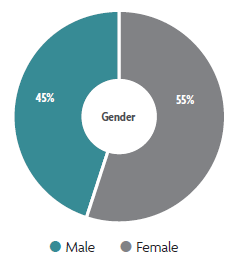
The Hyprop board recognises that diversity of skills, experience, background, knowledge, thought, culture, race and gender strengthens the board's ability to effectively carry out its duties and add value to the group. The board has formally adopted a policy of promoting gender diversity (which is available on our website) and will report on this on an annual basis. Currently the Hyprop board includes two female directors, namely Lindie Engelbrecht and Nonyameko Mandindi, translating to 20% of board members being female.
Hyprop recognises that it plays a vital role in advancing gender equality, first in the workplace and in broader society. We have implemented measures to ensure that women are given equal opportunities to grow in our organisation.
For further reading:
- For information on value of training by gender click here
- For percentage of females versus males per job grade click here
Race diversity at board level:
Hyprop recognises the importance of racial diversity at board level. Currently 20% of the board is racially diverse, with two black directors, Thabo Mokgatlha and Nonyameko Mandindi.
Because we understand that racial representation at all levels is important, we have implemented measures to ensure equal opportunity to grow in our organisation.
Labour relations
Hyprop has no unionised employees and there was no impact on the business of industrial or labour unrest during the year.
Health and safety
Our policy is to create a safe and healthy working environment, with procedures in place to manage occupational incidents, and compensation claims in line with legislation. In brief, we aim to:
- Provide a health and safety programme that is effective, of a high standard, and is continuously reviewed and improved
- Comply with statutory provisions for health, safety and environmental matters that affect employees, customers, contractors and the public
- Ensure that all employees are properly informed of their responsibilities for health, safety and environmental matters and discharge those effectively
- Encourage employees to participate in preventing accidents and preserving health
- Provide the resources and training to achieve these objectives.
Each shopping centre is responsible for executing this policy on site through its operations manager. At group level, the national facilities manager is responsible for biannual audit reports, drawing on submissions from each centre.
All centres conduct regular health and safety training for employees, while third-party suppliers perform annual health and safety audits.
All construction projects have health and safety consultants appointed to represent Hyprop and monitor activities on site. On large and complex projects such as Rosebank Mall, the contractor has its own health and safety officer managing contractor teams and subcontractors.
There were no serious casualties or injuries during the year at any of our properties or projects.
Health and safety training and awareness
The following health training and awareness sessions were arranged during the year:
| HIV and Aids | First aid | Fire
fighting |
Stress management | Personal hygiene and healthy lifestyle | Injury on duty | ||||||||
| Training workshops | ✓ | ✓ | |||||||||||
| Training facilitated by external contractors | ✓ | ✓ | ✓ | ✓ | |||||||||
| Health day consultations conducted by healthcare professionals | ✓ | ✓ | ✓ | ||||||||||
| Information distributed via the newsletters | ✓ | ✓ | ✓ | ✓ | |||||||||
| Employee awareness days | ✓ | ✓ | ✓ | ||||||||||
| Voluntary testing and counselling | ✓ | ✓ | ✓ |
The company is focused on informing and training employees on health and safety. Various initiatives were arranged during the year, including communication, through the quarterly newsletter and training workshops, facilitated by health professionals, private consultations and various health and safety issue focus days.
HIV/Aids
HIV/Aids remains an issue in South Africa that could affect the wellbeing of our employees, leading to emotional distress, absenteeism, employee turnover and lower productivity. As a formal risk assessment determined the impact of HIV/Aids on the group as negligible, Hyprop does not have targets for addressing its direct impact, nor does it have strategies for addressing indirect business risks (eg effect on customer base/supply chain).
Our formal HIV/Aids policy, reviewed annually, provides guidelines on creating a non-discriminatory workplace, dealing with HIV testing, confidentiality and disclosure, providing equitable employee benefits, dealing with dismissal and managing grievance procedures. It also ensures affected employees' rights to confidentiality.
Where employees willingly disclose their status, this is kept confidential, with Hyprop offering counselling, acceptance and support.
Every year, HIV/Aids awareness days are held at each centre management office by professional nurses, with an external service provider conducting voluntary counselling and testing programmes. Employees are offered the opportunity to test for HIV and to test cholesterol and stress levels.