
Chief executive officer's report
The proven quality of Hyprop’s specialist shopping centre portfolio underpinned consistent growth for the 12 months to 30 June 2016. At the interim stage, we raised our guidance to the market to expect distribution growth of 13% to 15% for the year, and we delivered 14,2%.

Over the past four years, we have made solid progress in geographically diversifying our portfolio, which spreads the risk of low economic growth in a particular region.

 Pieter Prinsloo, chief executive officer
Over the past four years, we have made solid progress in geographically diversifying our portfolio, which spreads the risk of low economic growth in a particular region.
As the listed property sector expands and competition intensifies, a disciplined strategy becomes increasingly important. While Hyprop’s strategy is detailed in strategic intent, I reiterate that key for our group is our focus on the type and quality of assets. In terms of type, we only consider ownership in large shopping malls. In terms of quality, we consider the location, dominance and quality of the mall itself. We focus on those with a strong consumer base and very strong tenant mix, and ensure they are well situated in key cities or strong metropolitan areas.
Against this background, a highlight of the year was our expansion into South-Eastern Europe after acquiring a 60% share in two Delta City malls in Montenegro and Serbia. Funded with EUR denominated loans, these acquisitions (detailed in property portfolio) are an attractive investment as they complement our strategy to acquire or develop high-quality, income-producing shopping centres in emerging markets.
The financial director’s report details corporate activity post year-end. In summary, we raised R700 million in new equity and issued new corporate bonds of R1,2 billion, used to repay bank debt, while non-core disposals strengthened our balance sheet by R365 million.
Over the past four years, we have made solid progress in geographically diversifying our portfolio, which spreads the risk of low economic growth in a particular region. At year-end, South Africa was still the source of over 80% of our distributable income. We do, however, expect to benefit further from our investments in South-Eastern Europe and sub-Saharan Africa which will be included for the full year.
Operational performance
A number of factors contributed to the growth in distributable earnings, including almost 9% growth in distributions from our South African portfolio, additional income from acquisitions in Nigeria, Montenegro and Serbia and the opening of Achimota Retail Centre in Ghana.
South Africa
Demand for retail space remained strong with vacancies in the domestic portfolio reducing to 0,8% from 1,3% a year ago, after new lettings at Somerset Mall, Willowbridge and Somerset Value Mart in our retail portfolio, and at Lakefield Office Park and Hyde Park offices.
Post year-end, in line with our strategy of disposing of non-core assets, we concluded sale agreements for Somerset Value Mart and Glenfield Office Park for R185 million and R180 million, respectively.
Trading overview
 |
 |
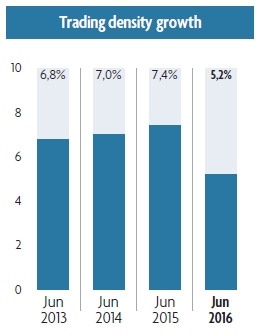
Trading density growth slowed during the period, primarily reflecting the impact of increased competition for The Glen. Excluding this centre, trading density growth for the rest of the portfolio was 6,4%. Similarly, excluding The Glen from the rent ratio leaves it unchanged year-on-year at 7,1%. The Glen remains a popular centre, and the impact of new competition is already subsiding. Initiatives are under way to stabilise trading densities and return The Glen to growth.
Leasing
Contractual lease escalations, the basis of growth in annual distributable income, dipped marginally to 8,1%. Rental growth on new leases and renewals slowed to 7,3%, primarily reflecting weak demand for space in our office portfolio, although vacancies improved to 4,5% from 8,3% in 2015.

It was another busy period, with 568 leases signed in South Africa, representing 153 664m2 (19,6% of our total portfolio by rentable area). Our focus remains on continuously improving the tenant mix by replacing weaker tenants with much stronger and sought-after retailers. We again accommodated the aims of local national tenants, for example Woolworths, to expand their store sizes, and capitalised on demand from international brands establishing a presence in South Africa. Notably, the first Starbucks outlet in South Africa opened in Rosebank in April 2016 and the first H&M in Hyprop’s portfolio opened at Clearwater Mall in the same month.
Edcon
We continue to monitor the financial stability of the Edcon Group. This remains a risk, as Edcon is the largest tenant group in our portfolio, occupying 9% of our portfolio by rentable area and contributing almost 7% of our income. Edcon’s issues relate mainly to high debt and its ability to provide credit to customers. During the year, Edcon restructured its debt to improve its financial position and strengthen its balance sheet. Analysed by trading density and profitability, most Edcon stores in our portfolio range from average to good, and we have appropriate contingency plans in place.
Platinum Group
Platinum Group stores were vacated and the space was relet.
Developments
We continued to enhance our existing portfolio, spending R178 million during the period on capital projects, replacing equipment and tenant installations. Included in our equipment spend was the cost of upgrading security systems at all our malls, installing additional generators at some malls, and installing smart-metering systems across our retail portfolio.
Completed projects are summarised below, while extensions are planned for Canal Walk and Rosebank Mall at an estimated project cost of R167 million. Key projects during the year included:
| Extensions and developments completed | ||
| Somerset Mall | Woolworths extension, food court upgrade, tenant relocations | |
| Clearwater Mall | H&M extension | |
| Under construction | ||
| Somerset Mall | Extension to accommodate a large H&M store — opening October 2016 | |
| Atterbury Value Mart | Checkers — opening November 2016 |
Customer security at our shopping centres remains a priority and, in line with our security strategy, we have installed up-to-date technology with improved results.
There are a number of masterplan expansion opportunities at some of our shopping centres, although implementation depends on planning approvals by local councils and the commitment of key tenants.
Sub-Saharan Africa
Our sub-Saharan Africa portfolio excludes South Africa. The review period was characterised by lower economic growth in Ghana, Zambia and Nigeria - our principal operating territories - accompanied by weakening local currencies.
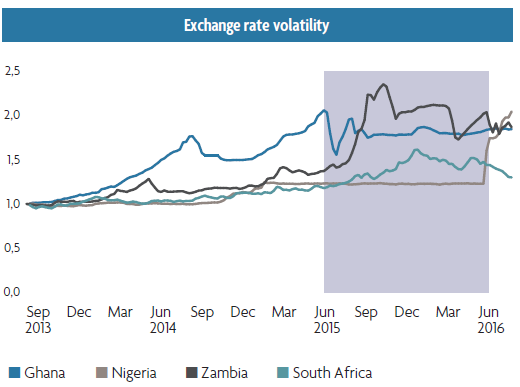
More positively, the defensive nature of our portfolio means it can withstand headwinds as our assets are in key cities where economic growth is higher than the country average. Equally, we believe the Hyprop portfolio is the largest and best quality in sub-Saharan Africa.
Investment in Sub-Saharan Africa (excluding SA)
| Centre | City and country | Hyprop % share | Rentable area m2 |
Vacancy % rentable area |
Foot-count/m2 | ||||
| Accra Mall | Accra, Ghana | 17,6 | 21 240 | 0 | 27 | ||||
| West Hills Mall | Accra, Ghana | 16,8 | 28 466 | 0 | 16 | ||||
| Achimota Retail Centre | Accra, Ghana | 28,1 | 15 170 | 18,0* | 28 | ||||
| Manda Hill | Lusaka, Zambia | 68,8 | 40 561 | 4,7 | 22 | ||||
| Ikeja City Mall | Lagos, Nigeria | 75,0 | 22 223 | 2,3 | 30 | ||||
| Average | 4,0 | ||||||||
| * Eight months of trading — opened in November 2015 |
Achimota Retail Centre opened in October 2015 and is trading well. We completed a USD9,5 million redevelopment of the food court and 1 000m2 extension at Accra Mall in April 2016. Our fourth property in Ghana, Kumasi City Mall, will open in April 2017.
South-Eastern Europe
After comprehensive due-diligence exercises, we acquired a 60% interest in two European malls in 2016.
With Hyprop’s share of the total purchase price being Eur121,6 million, these may be the first of similar acquisitions in South-Eastern Europe and will enhance our total shopping centre portfolio. Our objective is to partner with strong local developers and owners, aiming for partial ownership of a high-quality regional shopping centre portfolio, with a value of some Eur1 billion, within five years.
We are confident these acquisitions will enhance Hyprop’s distributions, as funding rates in Europe are comparatively low and both malls offer a healthy net income return of above 8%. Salient features of the properties include:
- Delta City Belgrade is a modern and well-established shopping centre (some 30 000m² of rentable space and over 120 shops) in New Belgrade, the most densely populated municipality in the capital city. The mall’s catchment area reaches 225 000 people, many within walking distance. High occupancy and footfall, plus a balanced tenant mix (including key retailers H&M and Zara) make this an attractive addition to our portfolio
- Delta City Podgorica is a contemporary and dominant shopping centre with almost 24 000m² of rentable retail space, and 80 shops including Zara, Guess, Tommy Hilfiger, Bata, Aldo, Gant and Orsay. The mall is on the main boulevard in Podgorica, Montenegro’s capital, with a catchment area of over 210 000 people.
Our entry to South-Eastern Europe complements our focus on emerging markets for numerous reasons, including strong economic growth off a lower base with lower taxes translating into a better return on investment. In addition, less competition means we can acquire better quality centres, and skilled labour is easily available.
Income-producing properties
| Centre | City and country | Hyprop % share | Rentable area m2 | Vacancy % rentable area | Foot-count/ m2 |
| Delta City Belgrade | Belgrade, Serbia | 60 | 29 876 | — | 28 |
| Delta City Podgorica | Podgorica, Montenegro | 60 | 23 729 | — | 19 |
At present, we envision internal changes to the Belgrade asset to improve the tenant mix and capitalise on demand for space. We are also considering the risk/reward benefits of increasing the Podgorica centre’s rentable area by 12 000m2.
Shareholding
Hyprop has a 100% free-float market capitalisation. Offshore shareholders increased to 26,3% from 25% in 2015. Trading volumes, however, slowed marginally to 71,8% from 73,0% in 2015. Post year-end, Hyprop outperformed the SAPY index, as shown below.

Top 10 beneficial shareholders
| Rank | Beneficial shareholder | % of issued share capital |
| 1 | Government Employees Pension Fund | 13,90 |
| 2 | Stanlib | 4,69 |
| 3 | Old Mutual | 4,57 |
| 4 | Vanguard | 3,39 |
| 5 | Investec | 3,01 |
| 6 | Eskom Pension and Provident Fund | 2,81 |
| 7 | Prudential Investment Managers | 2,40 |
| 8 | Sasol Pension Fund | 2,37 |
| 9 | Government of Singapore Investment Corporation | 2,31 |
| 10 | Investment Solutions | 2,27 |
Outlook and focus
The resilience of our growth strategies is reflected in our focus on owning quality shopping centres, catering to middle and higher-income consumers. Given Hyprop’s geographic diversity, it is pertinent to examine the outlook by region.
In South Africa, the current low economic growth rate is expected to be protracted. Any substantial weakening in the rand exchange rate raises the likelihood of further hikes in interest rates, with concomitant impacts along our value chain. However, Hyprop has excellent assets and a quality management team: we will focus on these assets by improving the tenant mix, maintain strong operational performances across the board, continue our programme of refurbishments and extensions where we see opportunities in our portfolio, and dispose of non-core assets.
For our operations in sub-Saharan Africa, we expect lower economic growth for calendar 2016, accompanied by more short-term currency volatility, particularly in Nigeria. However, consensus market analysis indicates a possible recovery towards the end of 2017 and into 2018. Our focus is to bed down our current developments to ensure they trade successfully and improve our operational performance.
The outlook for South-Eastern Europe is much more positive. Regionally, there are still good investment opportunities, obviously only at the right price and yields. Most of these countries are recording good economic growth. Equally, international brands are keen to enter these markets and prepared to pay a premium to establish their presence. This should support income growth in these centres. We will focus on expansion opportunities, potential acquisitions and appropriate development proposals.
Against this background, we forecast growth in distributions of around 10% for the financial year ahead. This forecast has not been reviewed or reported on by the company’s auditors.
Appreciation
Our board members continue to provide wise counsel and support, which are deeply appreciated. Equally, I thank our executive team and all our employees for their commitment and hard work, as well as our loyal service providers and tenants for their continued support.
Pieter Prinsloo
Chief executive officer